When shopping for new windows, you will likely encounter the ENERGY STAR label on product packaging, manufacturer websites, and showroom displays. It is one of the most widely recognized energy-efficiency marks in the country, but what it actually means and how it applies to your specific home are not always clear.
This guide covers everything you need to know about ENERGY STAR products, including how the program works, what the performance ratings on the window label measure and what they mean for your home, how the four U.S. climate zones affect which products qualify, and what financial incentives are currently available to help lower household energy bills over the life of your investment.
What Is ENERGY STAR, and Who Oversees It?
The ENERGY STAR program is a voluntary certification created by the U.S. Environmental Protection Agency (EPA) in 1992. Originally focused on office equipment, it has expanded to cover hundreds of product categories, including windows, doors, and skylights. ENERGY STAR windows are products that have been independently tested and certified to meet energy efficiency thresholds, tailored to the local climate where they will be installed.
The program’s voluntary nature matters for two reasons. Manufacturers who become ENERGY STAR partners have chosen to meet a higher standard than what building codes require. And as a homeowner, the label gives you confidence that a third party, not the manufacturer, has verified the performance claims attached to the product.
Which Window Style Is Right for Your Home?
Not sure where to start with replacement windows? We will help you narrow it down. Answer a few quick questions about your home, style preferences, and project goals. Then, we will recommend the window style and product option that best fits your needs - whether you want more natural light, better airflow, improved energy efficiency, easier maintenance, or a fresh new look. At the end, you will get your personalized window recommendation plus access to an exclusive quiz offer toward your project.
Select all that apply.
Almost Done
Get Your Quiz Results
Enter your email address to see your recommended window style. We will also email you a copy of your results.
How ENERGY STAR Windows Benefit Your Home
Homeowners who replace their old windows with ENERGY STAR-certified products typically notice improvements on several fronts, some immediate, others accumulating over time.
- Lower energy bills: Less heat escaping through the glass in winter and less solar heat entering in summer means your heating and cooling systems use less energy to maintain a set temperature. Installing ENERGY STAR-certified windows and doors can reduce household energy bills by up to 13% compared to non-certified products, according to EPA estimates.
- More comfortable rooms: Cold glass surfaces in winter create drafts and radiant cold that make rooms feel uncomfortable even when the thermostat is set correctly. A window with a low U-factor stays closer to room temperature, eliminating that effect near windows and exterior walls.
- Less condensation: Condensation on interior glass forms when the surface is cold enough to collect moisture from the air. Energy-efficient windows stay warmer on the interior face, which reduces or eliminates condensation, a meaningful benefit in the consistently damp Pacific Northwest climate.
- UV protection: Low-E glass that controls solar heat gain also filters a significant portion of ultraviolet light, the primary cause of fading in flooring, furniture, and window treatments. This benefit is ongoing and does not diminish over time.
- Reduced environmental impact: Using less energy to heat and cool your home reduces the demand placed on power plants, which in turn reduces greenhouse gas emissions. Choosing ENERGY STAR certified products is one of the more direct ways a homeowner can reduce their footprint without sacrificing comfort.

Schedule a Free Consultation
Get a free home window inspection, talk with one of our design consultants to get product recommendations, and learn about special offers and financing.
How ENERGY STAR Windows Are Certified and What the Ratings Mean
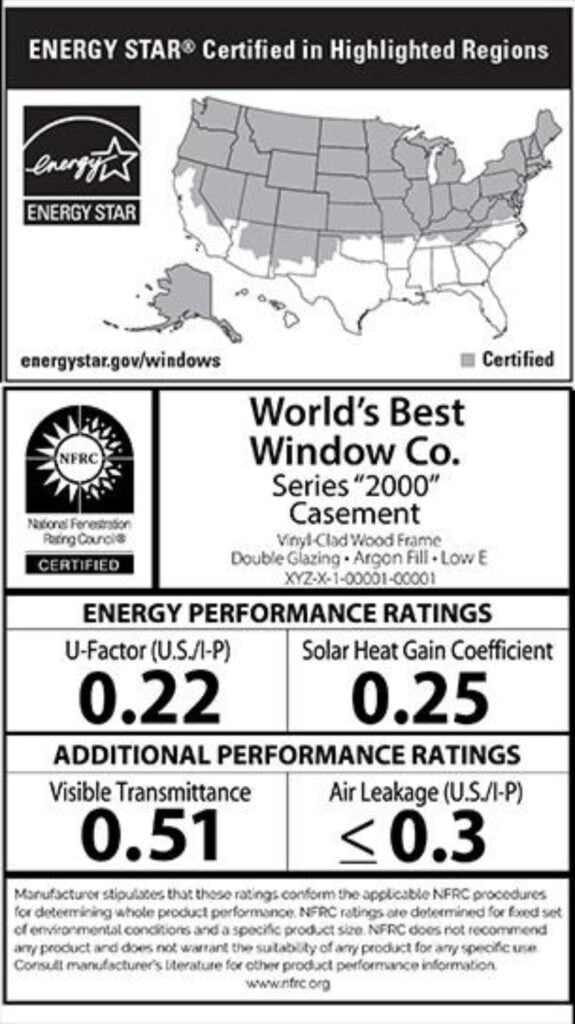
When comparing products, rely on the ENERGY STAR window label rather than manufacturer marketing language. A window marketed as “high-performance” or “energy efficient” may or may not meet the ENERGY STAR criteria, and the label gives you the independent data to find ENERGY STAR windows you can verify.
Earning ENERGY STAR certification is a multi-step process that no manufacturer can shortcut.
- An accredited independent laboratory tests the window to measure its performance characteristics.
- The National Fenestration Rating Council (NFRC) reviews the test results, assigns certified ratings, and issues the window label.
- The manufacturer, as an ENERGY STAR partner, submits the NFRC-certified data to the EPA.
- The EPA verifies that the ratings meet ENERGY STAR criteria for each climate zone the product is seeking to qualify for.
- The certified product is listed in the ENERGY STAR product database. Any subsequent change to the product’s specifications requires the process to start again.
Each rating on the window label measures a different aspect of how the window performs in your home.
U-Factor
U-factor measures how well the entire window assembly holds heat inside your home on a cold day. A lower U-factor means less heat loss through the window, which translates to less energy spent on heating and more comfortable rooms near the glass. It is the most important rating for homeowners in cold climates, where keeping heat in is the dominant energy challenge, and less critical but still relevant in warmer regions where the focus shifts to blocking heat rather than retaining it.
Solar Heat Gain Coefficient
Solar heat gain coefficient (SHGC) measures how much of the sun’s energy passes through the glass into your home. In hot climates, a lower SHGC keeps rooms cooler by blocking solar heat before it enters. In colder climates, the relationship is more nuanced. On south-facing walls, some solar gain is helpful in winter, reducing the load on your heating system and contributing to energy savings. This is why ENERGY STAR requirements for the Northern zone include a minimum SHGC, not just a maximum.
Visible Transmittance
Visible transmittance (VT) measures how much natural daylight passes through the glass, on a scale from zero to one. ENERGY STAR does not set a VT requirement, but the NFRC reports it on the window label because it affects daily comfort. A window with very low VT may keep rooms cooler on sunny days but leave them feeling dim regardless of the weather, which can increase your reliance on artificial lighting.
Air Leakage
Air leakage measures how much air moves through a closed window assembly. While the glass and frame determine how much heat conducts through the window, air leakage is determined by the quality of the weatherstripping, seals, and hardware. Even a well-insulated window can underperform if air is infiltrating around the edges, contributing to heat loss and wasted energy. ENERGY STAR requires an air leakage rating of 0.3 or lower. When comparing new windows, this rating reflects build quality in a way that glass specs alone do not capture.
ENERGY STAR Climate Zones Explained
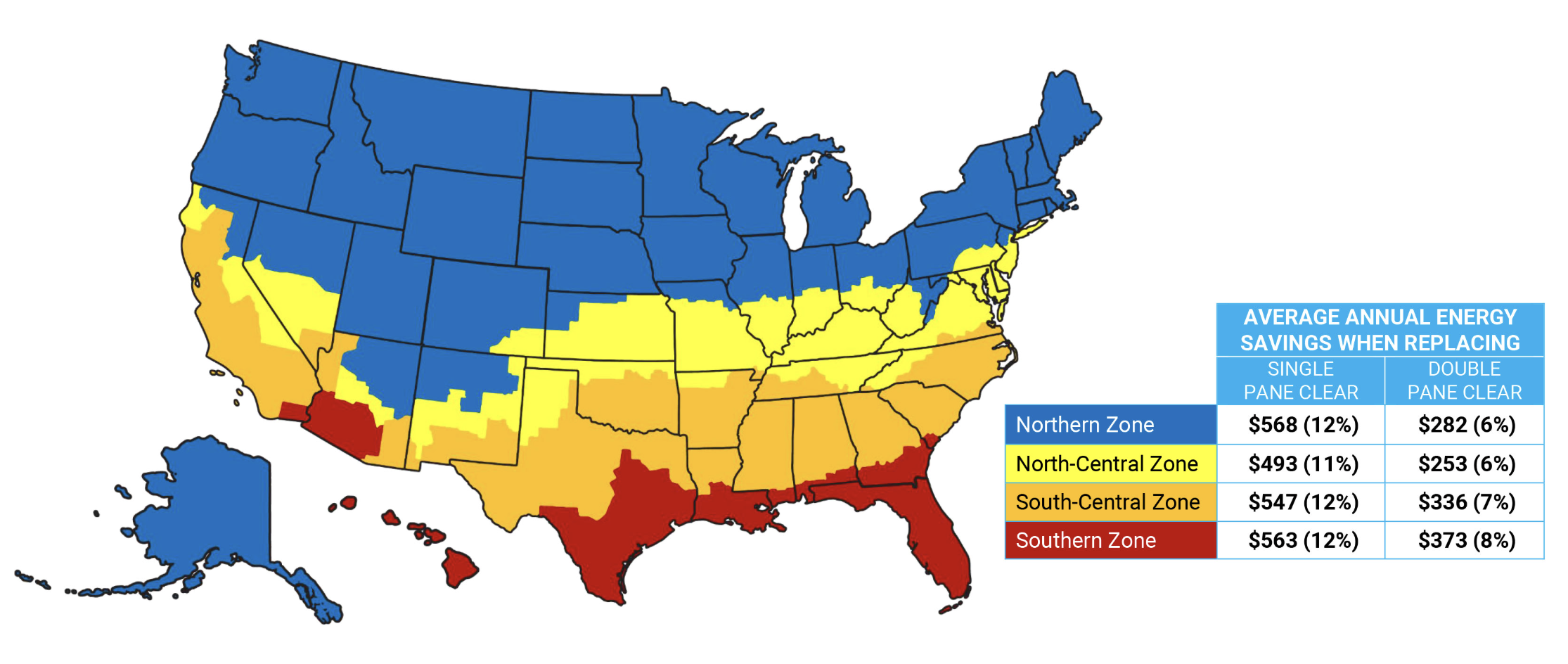
2023 research by D+R International conducted in support of Energy Star
The EPA divides the continental United States into four climate zones, each with its own certification requirements, because the energy challenge a window faces in Minneapolis is almost the opposite of the one it faces in Miami. The zone system ensures that a certified window is actually suited to the climate it will be installed in.
Northern Zone
The Northern zone covers the coldest U.S. climates, where winters are long, and heating costs are the dominant concern. ENERGY STAR sets the strictest insulation requirements here, and most qualifying window products are triple-pane. The zone also requires windows to allow a minimum level of passive solar gain, so certified products don’t shut out the free winter warmth that south-facing windows can provide. Homeowners replacing single-pane windows in the Northern zone see average annual savings of $568, adding up to roughly $17,040 over 30 years.
North-Central Zone
The North-Central zone sees intense winters and summers, so both heat retention and solar control matter. ENERGY STAR balances the requirements accordingly, and most qualifying products are high-performance double-pane. Average annual savings replacing single-pane windows are $493, or about $14,790 over 30 years.
South-Central Zone
In the South-Central zone, summer cooling costs are the bigger concern. Certified windows here are engineered primarily to limit how much solar heat enters the home, keeping rooms cooler without overworking the air conditioning. Average annual savings replacing single-pane windows are $547, or around $16,410 over 30 years.
Southern Zone
The Southern zone is the hottest and most cooling-dominated of the four. Blocking solar heat is the priority, and insulation requirements are comparatively relaxed since heat retention matters far less. Despite the warmer baseline, replacing old single-pane windows still produces average annual savings of $563, or roughly $16,890 over 30 years.
Tax Credits and Utility Rebates for ENERGY STAR Windows
The federal Section 25C Residential Clean Energy Credit, established under the Inflation Reduction Act, offered homeowners up to $600 back on qualifying window products. That credit expired for installations completed after December 31, 2025.
Utility rebate programs in Washington State remain active and are now the primary financial incentive available to homeowners looking to reduce energy bills through window upgrades. Eligibility and amounts vary by provider.
Why Professional Installation Matters for ENERGY STAR Performance
A window’s certified ratings are established under controlled laboratory conditions. Whether those ratings translate to real-world performance in your home depends entirely on how the window is installed. There are two common ways installation can undermine a product that has tested well.
- Water infiltration. If flashing, sealants, and drainage planes are not properly integrated around the frame, water can work its way behind the window and compromise both the window itself and the surrounding wall assembly. This is the most consequential installation failure, and the least visible until damage has already occurred.
- Air infiltration. A window with an excellent air leakage rating can still allow significant drafts into the home if the gap between the frame and the rough opening is not properly sealed. The rating measures the window. The seal measures the installation.
One distinction worth understanding: meeting local building code and choosing ENERGY STAR certified products are two separate things. A window can be legally installed without carrying ENERGY STAR certification, just as a certified window can be installed poorly enough to prevent it from performing as rated. Certification tells you what the product is capable of. Installation determines what it actually delivers.
Ready to Experience ENERGY STAR Windows in Your Home?
Choosing the right ENERGY STAR certified windows for a Pacific Northwest home involves more than finding a product with the right window label. You need products rated for the Northern zone, installed by a team that understands how to protect the window opening against Washington’s weather.
At Lake Washington Windows and Doors, that combination is what we bring to every project. Request a complimentary in-home consultation today, and we’ll walk you through your options, the current incentives available in your area, and what the installation process looks like from start to finish.