Federal energy tax credits for home improvement, including the credit that once covered replacement windows and doors, no longer exist. Congress ended them at the close of 2025, and there is no federal replacement currently in effect. But that does not mean homeowners are completely out of options. Many local utilities still have home energy rebates available, state-level assistance might be a possibility, and financing options are still available in many parts of the country.
This article explains what happened to the federal credit, what options remain, and for homeowners in Western Washington specifically, which programs are active and how to access them.
What Was the Section 25C Energy Efficient Home Improvement Credit?
The Section 25C Energy Efficient Home Improvement Credit was a federal tax credit that allowed homeowners to claim 30% of the cost of qualifying energy-efficient upgrades to their primary residence. Originally introduced as a lifetime credit capped at $500, it was expanded under the Inflation Reduction Act and scheduled to remain available through 2032.
For windows and skylights, the annual cap was $600. Across all eligible improvement categories, including insulation, exterior doors, and certain HVAC systems, the total annual credit was capped at $1,200. It also covered heat pump water heaters and home energy audits under the same annual cap. Each category carried its own sublimit, meaning the $1,200 total could not be stacked entirely on a single improvement type.
The credit was nonrefundable, meaning any amount that exceeded your tax bill could not be refunded or carried into future tax years, and it only applied to existing homes used as a primary residence, not to new construction or rental properties. Because the annual limit reset each calendar year, a homeowner could claim it in multiple years for different improvements, but labor costs for installation were not eligible. Only the cost of the windows or other qualifying product counted.
Which Window Style Is Right for Your Home?
Not sure where to start with replacement windows? We will help you narrow it down. Answer a few quick questions about your home, style preferences, and project goals. Then, we will recommend the window style and product option that best fits your needs - whether you want more natural light, better airflow, improved energy efficiency, easier maintenance, or a fresh new look. At the end, you will get your personalized window recommendation plus access to an exclusive quiz offer toward your project.
Select all that apply.
Almost Done
Get Your Quiz Results
Enter your email address to see your recommended window style. We will also email you a copy of your results.
Why the Section 25C Credit Is No Longer Available
The One Big Beautiful Bill Act, signed into law on July 4, 2025, accelerated the termination of several federal energy credits, including Section 25C.
The credit was terminated for any property placed in service (meaning installed and operational) after December 31, 2025. If you have questions about an installation completed before that date, consult a tax professional.
For any window or door installation completed on or after January 1, 2026, no federal tax credit is available.

Schedule a Free Consultation
Get a free home window inspection, talk with one of our design consultants to get product recommendations, and learn about special offers and financing.
What Homeowners Can Do Instead

The end of Section 25C shifts the conversation from federal home improvement tax credits to local programs. Depending on where you live, meaningful ways to save money on a window replacement project are still available through utility rebates, state assistance, and financing. The best starting point is usually the closest one.
Speak to a Qualified Installer
A knowledgeable local window installer is often the most efficient first call a homeowner can make. Experienced installers work with utility rebate programs regularly, know which products qualify, and can tell you what is currently available in your specific service area before you spend time researching on your own. They can also help you understand what documentation you will need to submit and walk you through the application process.
Beyond rebates, many dealers and installers offer their own promotions, financing plans, and discounts that can meaningfully offset the cost of a project, independent of any utility or government program. It is worth asking about both when you speak to them.
Check Your Utility Provider
Most major electric and gas utilities run their own rebate programs for energy-efficient window replacements, separate from any federal program. These programs typically pay a flat amount per window or a rate per square foot, and they require new windows to meet energy efficiency standards set by the utility. Many also require windows to meet Energy Star certification. To find your utility’s current program, search your utility’s name plus “window rebate” or visit their website and look under energy efficiency or rebates.
Look Into State-Level Programs
Many states run their own programs funded through state energy legislation, separate from federal policy. These programs vary significantly in scope and eligibility, and some are limited to income-qualified households.
The Database of State Incentives for Renewables and Efficiency (DSIRE) is a free, regularly updated resource that lets you search by state and by improvement type to see what is currently available where you live.
Look for Manufacturer Rebates
Window manufacturers occasionally run their own rebate or incentive programs, separate from utility programs. These are less consistent than utility rebates but are worth checking when you are selecting a product. Ask your installer or check the manufacturer’s website directly at the time of purchase.
Use the Energy Star Rebate Finder
Energy Star maintains a rebate finder tool that aggregates utility and program rebates by zip code. It is a useful cross-check once you have identified your utility, and it can surface programs you might not have found otherwise.
Consider Financing
The tax credit reduced your total cost outright. Financing works differently: it spreads the cost over time rather than reducing it. Whether that makes sense depends on the terms available to you. Zero-interest options, including utility-offered financing programs like the one offered by Tacoma Public Utilities in Western Washington, can make a project manageable without a large upfront payment. Interest-bearing loans require more scrutiny, but for homeowners who would otherwise delay a project indefinitely, getting the work done sooner also means the energy savings start sooner.
General Rebate Eligibility Requirements
While specific requirements vary by program and utility, most window rebate programs across the country share a common set of eligibility criteria. If you are planning a project with rebates in mind, check these boxes before getting started.
- Existing window type. Most programs require that you replace single-pane windows or double-pane windows with metal frames. Replacing a double-pane vinyl window with a better double-pane vinyl window typically does not qualify.
- Energy performance standard. New windows must meet a minimum thermal efficiency rating to qualify. Most programs use U-factor, a measure of how well a window insulates, as the qualifying metric. Lower U-factors earn larger rebates in tiered programs. Some programs instead pay a flat rate per square foot and do not require a specific U-factor.
- Contractor requirements. Most programs require installation by a registered or participating contractor. Self-installations and warranty replacements are generally not eligible.
- Property type. Most programs cover owner-occupied single-family homes, townhomes, condominiums, and smaller multifamily buildings. Manufactured homes and new construction typically do not qualify, though some programs may have exceptions.
- Application timing. Rebate applications typically must be submitted within 60 to 90 days of installation.
For Washington Homeowners: Rebates Still on the Table
Washington is one of the better states in the country for window replacement rebates. The programs below span investor-owned utilities, public utility districts (PUDs), electric cooperatives, and city-owned utilities. Which one applies to you depends entirely on your address. If you are not sure which utility serves your home, your electric bill will tell you.
Investor-Owned Utilities
Washington’s investor-owned utilities, privately held companies regulated by the state Utilities and Transportation Commission, collectively serve a large portion of the state’s residential customers, and all three run active window rebate programs.
- Puget Sound Energy is the largest, serving most of King, Pierce, Snohomish, and Kitsap counties. Their window rebate program is active through the end of 2026 and is open to customers who use PSE electricity or natural gas as their primary heating source.
- Avista Utilities serves much of Eastern Washington, including Spokane and surrounding communities, and offers rebates for qualifying window and sliding door replacements in electrically or gas-heated homes.
- Pacific Power (Wattsmart) serves parts of southeastern and south-central Washington through its Wattsmart Homes program, which covers window replacements in electrically heated existing homes.
Public Utility Districts
Washington has 29 public utility districts, which are locally governed, customer-owned utilities that serve both rural and urban communities across the state. Many of them administer window rebate programs through conservation partnerships with the Bonneville Power Administration (BPA), the federal agency that markets hydroelectric power across the Pacific Northwest and funds regional energy efficiency programs.
Rebate structures vary by district, typically paying either a flat amount per window or a rate per square foot. Most PUD programs require electric heat as the primary heating source. That requirement exists because these programs are funded through electricity conservation budgets. These programs are designed to reduce demand on the electric grid, so they are limited to homes where replacing windows would directly lower electricity use. Of Washington’s 23 PUDs, 15 have active window rebate program pages on their websites at the time of research.
- Benton PUD
- Chelan County PUD
- Clallam County PUD
- Clark Public Utilities
- Cowlitz County PUD
- Grant County PUD
- Grays Harbor PUD
- Jefferson County PUD
- Klickitat County PUD
- Lewis County PUD
- Okanogan County PUD
- Pacific County PUD No. 2
- Skamania County PUD
- Snohomish County PUD
- Wahkiakum County PUD
Electric Cooperatives
Washington’s electric cooperatives are member-owned utilities, similar to PUDs in structure but organized under cooperative law. Several of them run robust window rebate programs, including dedicated program pages and income-qualified tiers that can significantly increase rebate amounts for eligible households.
- Benton REA
- Columbia Rural Electric Association
- Elmhurst Mutual Power & Light
- Inland Power & Light
- OPALCO (Orcas Power & Light)
- Tanner Electric Cooperative
Municipal Utilities
Several Washington cities own and operate their own electric utilities, independent of the state’s PUDs and investor-owned providers. Program quality varies considerably among them. Some offer among the most generous window rebate structures in the state, while others offer no program at all.
Tacoma Power offers not just rebates but also a five-year, 0% interest loan of up to $8,000, and a deferred loan plus rebate option for income-qualified customers. Here are the current municipal utility programs available:
- Blaine City Light
- Cheney Power
- Ellensburg Electric
- Port Angeles City Light
- Richland Energy Services
- Steilacoom Electric
- Tacoma Power
Washington State Programs
Two state-administered programs from the Washington State Department of Commerce Weatherization Assistance Program are worth knowing about. Both target income-qualifying households to provide free energy-efficiency improvements, potentially including window replacement, to households at or below 200% of the federal poverty level.
Applications are handled through local Community Action Agencies rather than the state directly. Find your local agency through the Department of Commerce.
Replacement Windows Still Pay for Themselves
The Section 25C credit was a helpful one-time benefit but a modest one. The stronger case for replacing your windows is what they do for your energy bills every month after installation. Old single-pane and metal-frame windows are common sources of air leaks that force your heating system to work harder year-round. Replacing them with high-performance windows helps you save money continuously, and those savings compound over a lifespan measured in decades.
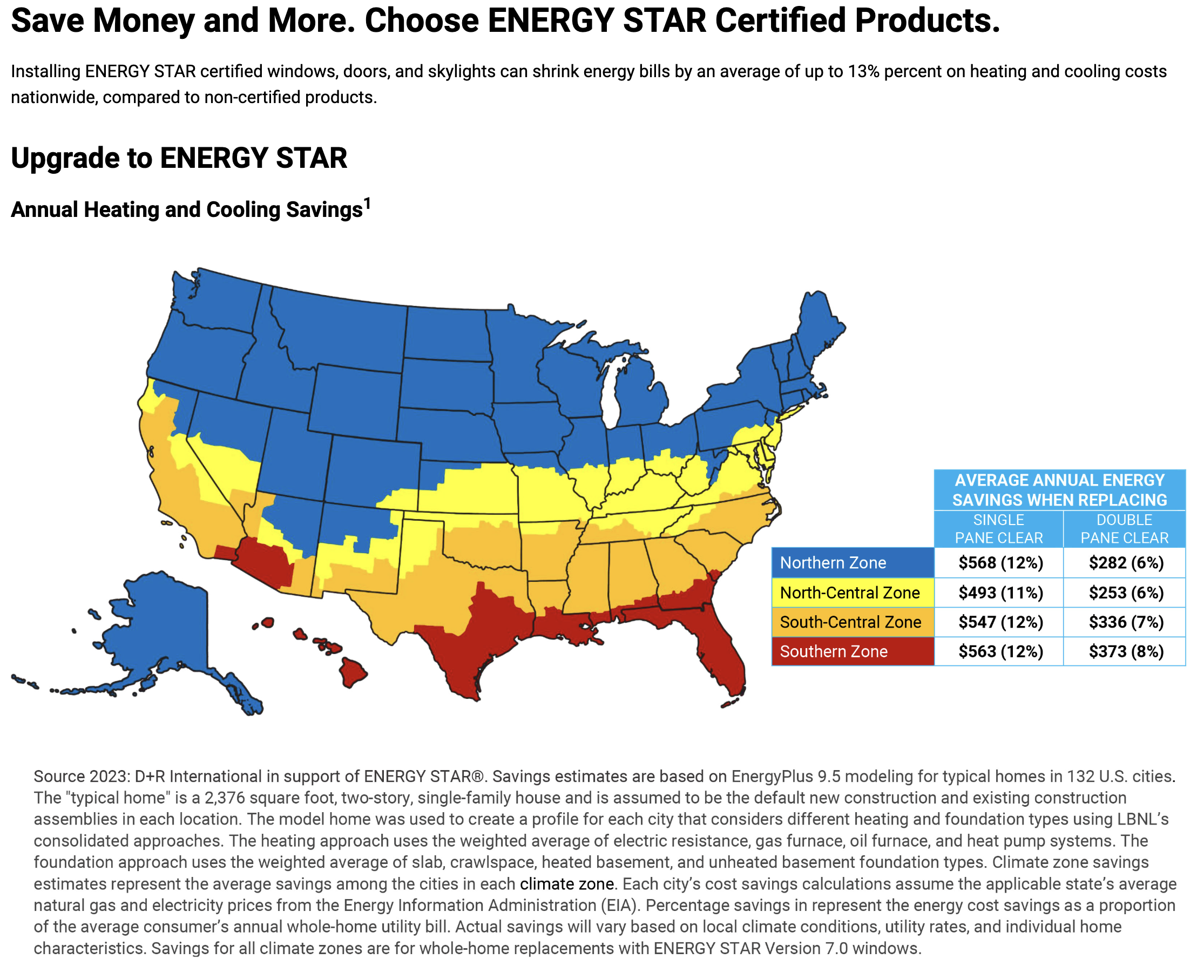
According to 2023 research by D+R International conducted in support of Energy Star, upgrading to Energy Star-certified windows can produce the following savings:
| Savings | Northern Zone | North-Central Zone | South-Central Zone | Southern Zone |
| Annual single-pane | $568 | $493 | $547 | $563 |
| 30-year lifetime | $17,040 | $14,790 | $16,410 | $16,890 |
| 50-year lifetime | $28,400 | $24,650 | $27,350 | $28,150 |
| Annual double-pane | $282 | $253 | $336 | $373 |
| 30-year lifetime | $8,460 | $7,590 | $10,080 | $11,190 |
| 50-year lifetime | $14,100 | $12,650 | $16,800 | $18,650 |
Beyond energy, window replacements in 2026 recoup an average of 50% to 75% of their cost in immediate home resale value. Additionally, efficient windows reduce your HVAC workload by 15% to 30%, potentially extending the life of your furnace and AC by several years.
Professional Installation Protects the Payback
The performance gains that make replacement windows worth the cost only materialize if the windows are installed correctly. A high-performance window set into a poorly prepared opening, without proper flashing, sealing, and air barrier integration to prevent air leaks, will underperform from day one. In a wet climate like Western Washington, an improper installation can cost you energy savings and create a pathway for water intrusion that can cause structural damage over time.
Choosing a qualified installer is the step that guarantees the payback. Look for a licensed, bonded contractor with documented window installation experience, verifiable references, and a written installation warranty. If your utility rebate program requires a registered or participating contractor, that registration is a useful baseline indicator, since those contractors are trained to meet the program’s technical specifications.
Choose an Energy-Efficient Window Dealer You Can Trust
At Lake Washington Windows and Doors, every installation is backed by our proprietary Leak Armor Guarantee, a commercial-grade system using layered flashing, pans, and sealants to protect against water intrusion in every climate condition Western Washington produces. It is included with every project at no additional cost, because an installation that performs as designed for the life of the window is the only kind worth doing.
If you are a Western Washington homeowner considering window replacement, Lake Washington Windows and Doors can help you navigate which utility rebates apply to your home, identify the right products for your project, and provide a detailed estimate with financing options before you commit to anything. Request a complimentary in-home consultation today.