Most residential replacement windows are manufactured in standard sizes of consistent width and height intervals that align with common rough opening dimensions used in modern construction. Understanding these standard size ranges can help you determine whether your existing opening will accept a stock window or require a custom unit.
In this guide, you’ll learn how standard window sizes are structured, how rough openings and window size notations work, and what dimensions are most common for each window style. Whether you are replacing an existing unit or planning a renovation, knowing how window sizing works makes the selection process far more straightforward.
Standard Window Sizes at a Glance
Before diving into individual window styles and detailed charts, it helps to see the most common standard window sizes side by side. While manufacturers vary slightly, the dimensions below represent common nominal window sizes based on rough opening measurements and include the full window unit, not just the glass.
| Window Type | Common Width Range | Common Height Range | Frequently Used In |
| Double hung | 24″ – 48″ | 36″ – 72″ | Bedrooms, hallways |
| Single hung | 24″ – 48″ | 36″ – 72″ | Bedrooms, kitchens |
| Picture | 24″ – 96″ | 24″ – 96″ | Living rooms, dining room |
| Casement | 18″ – 36″ | 18″ – 72″ | Kitchens, bathrooms |
| Horizontal sliding | 36″ – 84″ | 24″ – 60″ | Basements, bedrooms |
| Awning | 18″ – 72″ | 18″ – 72″ | Bathrooms, basements |
| Bay & bow | 42″ – 126″+ | 36″ – 72″ | Living rooms, bedrooms |
How Are Windows Measured?
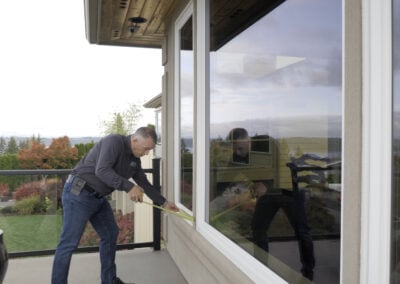
Accurate window measurements are essential before ordering a replacement unit. The measuring process follows a consistent sequence to ensure the new window fits properly within the existing opening.
- Frame squareness is verified. The window frame is checked to confirm that all four corners sit at consistent 90-degree angles.
- Width is measured in three locations. The opening is measured at the top, middle, and bottom. The smallest of these measurements is used for ordering the replacement window.
- Height is measured in three locations. Measurements are taken at the left, center, and right of the opening. Again, the smallest measurement is used.
- Frame depth is measured. The distance from the interior trim to the exterior trim is recorded to confirm there is sufficient space for the replacement unit.
- Measurements are finalized. Dimensions are typically rounded to the nearest ⅛ inch before ordering, and are always recorded as the window’s width x height.
These combined measurements determine the correct replacement window size and help ensure the new unit fits properly within the existing opening.

Schedule a Free Consultation
Get a free home window inspection, talk with one of our design consultants to get product recommendations, and learn about special offers and financing.
Understanding Rough Opening Size
The rough opening is the framed space in the wall where a window is installed. It includes the header at the top, the sill at the bottom, and the vertical framing members on each side. Rough opening dimensions are intentionally larger than the actual window unit.
In most residential construction, the rough opening is typically about ½ inch wider and taller than the window being installed. This additional space allows the installer to position the window properly, make minor adjustments for leveling and squaring, and apply insulation around the frame. Once installed, the gap between the window unit and the rough opening is sealed to improve energy efficiency and prevent air or moisture intrusion.
Understanding rough opening size is important because standard window size codes are based on these framed openings, not the exact outside dimensions of the finished window unit.
Window Size Notation Explained
Standard window sizes are commonly written using a four-digit code that represents the rough opening width and height. The first two digits indicate the width in feet and inches, and the second two digits indicate the height. These codes are based on the rough opening, not the exact manufactured unit size.
Here are common standard window size codes explained in plain terms:
- 2030 window = 2 feet 0 inches wide x 3 feet 0 inches tall (24″ x 36″)
- 3040 window = 3 feet 0 inches wide x 4 feet 0 inches tall (36″ x 48″)
- 4060 window = 4 feet 0 inches wide x 6 feet 0 inches tall (48″ x 72″)
- 4052 window = 4 feet 0 inches wide x 5 feet 2 inches tall (48″ x 62″)
When a window installer orders a 2030 window, it refers to a rough opening that measures approximately 24 inches wide by 36 inches tall. The manufactured window unit itself will typically be about ½ inch smaller in both width and height to allow room for installation and insulation.
Below is a reference chart of common standard window size codes and their corresponding dimensions.
| Height ↓ / Width → | 24″ | 28″ | 32″ | 36″ | 40″ | 44″ | 48″ | 60″ | 72″ |
| 36″ | 2030 | 2430 | 2830 | 3030 | 3430 | 3830 | 4030 | 5030 | 6030 |
| 44″ | 2038 | 2438 | 2838 | 3038 | 3438 | 3838 | 4038 | 5038 | 6038 |
| 48″ | 2040 | 2440 | 2840 | 3040 | 3440 | 3840 | 4040 | 5040 | 6040 |
| 52″ | 2044 | 2444 | 2844 | 3044 | 3444 | 3844 | 4044 | 5044 | 6044 |
| 54″ | 2046 | 2446 | 2846 | 3046 | 3446 | 3846 | 4046 | 5046 | 6046 |
| 60″ | 2050 | 2450 | 2850 | 3050 | 3450 | 3850 | 4050 | 5050 | 6050 |
| 62″ | 2052 | 2452 | 2852 | 3052 | 3452 | 3852 | 4052 | 5052 | 6052 |
| 72″ | 2060 | 2460 | 2860 | 3060 | 3460 | 3860 | 4060 | 5060 | 6060 |
Standard Window Sizes by Window Style
Each window style is manufactured within specific width and height ranges based on how it operates and how the frame is engineered. Hinged windows, such as casement and awning units, are limited by sash weight and hardware strength. Sliding windows are constrained by track span and structural rigidity. Double-hung windows must balance sash weight and frame strength to operate smoothly.
Because of these structural and mechanical factors, the minimum and maximum sizes vary by style. Below are the most common standard size ranges for each type, reflecting the dimensions most frequently used in residential replacement projects.
Double-Hung Window Sizes
Double-hung windows feature two operable sashes, one on the top and one on the bottom, that slide vertically within the frame. This allows ventilation from the top, bottom, or both at the same time. In addition to improving airflow compared to single-hung windows, double-hung windows offer an added safety benefit for families with young children, since the upper sash can be opened to allow fresh air in while remaining out of reach.
 24″ 24″ |
 28″ 28″ |
 32″ 32″ |
 40″ 40″ |
 44″ 44″ |
 48″ 48″ |
|
| 36″ |  2030 2030 |
 2430 2430 |
 2830 2830 |
 3430 3430 |
 3830 3830 |
 4030 4030 |
| 44″ | 2038 |
 2438 2438 |
 2838 2838 |
 3438 3438 |
 3838 3838 |
 4038 4038 |
| 48″ |  2040 2040 |
 2440 2440 |
 2840 2840 |
 3440 3440 |
 3840 3840 |
 4040 4040 |
| 52″ |  2044 2044 |
 2444 2444 |
 2844 2844 |
 3444 3444 |
 3844 3844 |
 4044 4044 |
| 54″ |  2046 2046 |
 2446 2446 |
 2846 2846 |
 3446 3446 |
 3846 3846 |
 4046 4046 |
| 60″ |  2050 2050 |
 2450 2450 |
 2850 2850 |
 3450 3450 |
 3850 3850 |
 4050 4050 |
| 62″ |  2052 2052 |
 2452 2452 |
 2852 2852 |
 3452 3452 |
 3852 3852 |
 4052 4052 |
| 72″ |  2060 2060 |
 2460 2460 |
 2860 2860 |
 3460 3460 |
 3860 3860 |
 4060 4060 |
Single-Hung Window Sizes
Single-hung windows, also referred to as single-sash windows, are among the most common window types in residential construction. They feature a fixed upper sash and an operable lower sash that slides vertically to provide ventilation. Single-hung windows are typically more affordable and slightly simpler in design than double-hung windows, and the fixed upper sash can contribute to improved energy efficiency.
| 24″ |
28″ |
32″ |
40″ |
44″ |
48″ |
|
| 36″ |  2030 2030 |
 2430 2430 |
 2830 2830 |
 3430 3430 |
 3830 3830 |
 4030 4030 |
| 44″ |  2038 2038 |
 2438 2438 |
 2838 2838 |
 3438 3438 |
 3838 3838 |
 4038 4038 |
| 48″ |  2040 2040 |
 2440 2440 |
 2840 2840 |
 3440 3440 |
 3840 3840 |
 4040 4040 |
| 52″ |  2044 2044 |
 2444 2444 |
 2844 2844 |
 3444 3444 |
 3844 3844 |
 4044 4044 |
| 54″ |  2046 2046 |
 2446 2446 |
 2846 2846 |
 3446 3446 |
 3846 3846 |
 4046 4046 |
| 60″ |  2050 2050 |
 2450 2450 |
 2850 2850 |
 3450 3450 |
 3850 3850 |
 4050 4050 |
| 62″ |  2052 2052 |
 2452 2452 |
 2852 2852 |
 3452 3452 |
 3852 3852 |
 4052 4052 |
| 72″ |  2060 2060 |
 2460 2460 |
 2860 2860 |
 3460 3460 |
 3860 3860 |
 4060 4060 |
Picture Window Sizes
Picture windows are fixed windows typically made with a single large pane of glass designed to maximize natural light and provide unobstructed views of a home’s surroundings. Because they do not open, they do not provide ventilation. However, the fixed design allows for a tighter seal, which can improve energy efficiency. Picture windows are available in a wide range of standard sizes, from smaller accent units to large openings used in living rooms and main gathering spaces.
| 24″ |
 36″ 36″ |
48″ |
 60″ 60″ |
 72″ 72″ |
 96″ 96″ |
|
| 24″ |  2020 2020 |
 3020 3020 |
 4020 4020 |
 5020 5020 |
 6020 6020 |
 8020 8020 |
| 36″ |  2030 2030 |
 3030 3030 |
 4030 4030 |
 5030 5030 |
 6030 6030 |
 8030 8030 |
| 48″ |  2040 2040 |
 3040 3040 |
 4040 4040 |
 5040 5040 |
 6040 6040 |
 8040 8040 |
| 52″ |  2044 2044 |
 3044 3044 |
 4044 4044 |
 5044 5044 |
 6044 6044 |
 8044 8044 |
| 60″ |  2050 2050 |
 3050 3050 |
 4050 4050 |
 5050 5050 |
 6050 6050 |
 8050 8050 |
| 62″ |  2052 2052 |
 3052 3052 |
 4052 4052 |
 5052 5052 |
 6052 6052 |
 8052 8052 |
| 72″ |  2060 2060 |
 3060 3060 |
 4060 4060 |
 5060 5060 |
 6060 6060 |
 8060 8060 |
| 96″ |  2080 2080 |
 3080 3080 |
 4080 4080 |
 5080 5080 |
 6080 6080 |
 8080 8080 |
Casement Window Sizes
Casement windows are hinged along one vertical side and open outward, typically using a hand crank at the bottom of the frame. This design allows the entire sash to swing open, providing excellent ventilation and directing airflow into the home. French casement windows feature two operable sashes that meet in the center and open without a vertical post in between, creating a wider opening. Modern casement windows are sealed with gaskets along the frame, which helps improve energy efficiency compared to many sliding window designs.
 18″ 18″ |
 20″ 20″ |
24″ |
 30″ 30″ |
36″ |
|
| 18″ |  1616 1616 |
 1816 1816 |
 2016 2016 |
 2616 2616 |
 3016 3016 |
| 20″ |  1618 1618 |
 1818 1818 |
 2018 2018 |
 2618 2618 |
 3018 3018 |
| 24″ |  1620 1620 |
 1820 1820 |
 2020 2020 |
 2620 2620 |
 3020 3020 |
| 30″ |  1626 1626 |
 1826 1826 |
 2026 2026 |
 2626 2626 |
 3026 3026 |
| 36″ |  1630 1630 |
 1830 1830 |
 2030 2030 |
 2630 2630 |
 3030 3030 |
| 48″ |  1640 1640 |
 1840 1840 |
 2040 2040 |
 2640 2640 |
 3040 3040 |
| 60′ |  1650 1650 |
 1850 1850 |
 2050 2050 |
 2650 2650 |
 3050 3050 |
| 72″ |  1660 1660 |
 1860 1860 |
 2060 2060 |
 2660 2660 |
 3060 3060 |
Horizontal Sliding Window Sizes
Horizontal-sliding windows are another prevalent window style, perhaps the most common. This style consists of two or three sashes mounted next to each other horizontally. They can be single sliders or double sliders, with one or two sashes opening past the others by sliding horizontally along a track at the bottom of the window. Horizontal-sliding windows are versatile and relatively cost-effective. However, they are considered slightly less energy efficient than hinged windows.
| 36″ |
48″ |
60″ |
72″ |
 84″ 84″ |
|
| 24″ |  3020 3020 |
 4020 4020 |
 5020 5020 |
 6020 6020 |
 7020 7020 |
| 36″ |  3030 3030 |
 4030 4030 |
 5030 5030 |
 6030 6030 |
 7030 7030 |
| 48″ |  3040 3040 |
 4040 4040 |
 5040 5040 |
 6040 6040 |
 7040 7040 |
| 60″ |  3050 3050 |
 4050 4050 |
 5050 5050 |
 6050 6050 |
 7050 7050 |
Awning Window Sizes
Awning windows are hinged at the top and open outward from the bottom of the frame, typically using a hand crank. This design allows ventilation while helping shield the opening from light rain. Because the sash presses tightly against the frame when closed, awning windows generally provide strong energy performance. Their compact proportions make them well-suited for higher wall placements, basements, and areas where wider window styles may not fit.
Bay Window Sizes
Bay and bow windows are multi-panel window assemblies that project outward from the exterior wall, creating additional interior space and expanding the viewing angle. A traditional bay window typically includes a large fixed picture window in the center with operable casement, single-hung, or double-hung windows on the angled sides for ventilation. Bow windows use a series of evenly spaced panels to create a more curved appearance. The extended sill area inside the home often allows space for a seat or shelf within the alcove.
Bay and Bow Window Options
| Bay or Bow Window | Projection Angle | Total Window “Lites” | Total Angled “Lites” | % of Glass Surface Per | Total Main “Lites” | % of Glass Surface Per |
| Bay | 25° | 3 | 2 | 1/4 | 1 | 1/2 |
| Bay | 35° | 3 | 2 | 1/4 | 1 | 1/2 |
| Bay | 45° | 3 | 2 | 1/4 | 1 | 1/2 |
| Bow | 25° | 3 | 2 | 1/3 | 1 | 1/3 |
| Bow | 35° | 3 | 2 | 1/3 | 1 | 1/3 |
| Bow | 45° | 3 | 2 | 1/3 | 1 | 1/3 |
| Bow | 10° | 4 | 4 | 1/4 | 0 | 0 |
| Bow | 15° | 4 | 4 | 1/4 | 0 | 0 |
| Bow | 10° | 5 | 5 | 1/5 | 0 | 0 |
| Bow | 15° | 5 | 5 | 1/5 | 0 | 0 |
| Bow | 10° | 6 | 6 | 1/6 | 0 | 0 |
| Bow | 15° | 6 | 6 | 1/6 | 0 | 0 |
Egress Window Size Requirements
Egress windows provide a safe emergency exit, most commonly from a bedroom or finished basement. Because they must allow a person to climb through them quickly and safely, they must meet minimum size standards.
These standards apply to the clear opening, which is the actual space available when the window is fully opened. A window may have a large frame but still fail to meet egress requirements if the operable opening is too small. In most residential situations, an egress window must provide:
- At least 5.7 square feet of clear opening area
- A minimum clear opening width of 20 inches
- A minimum clear opening height of 24 inches
- A maximum sill height of 44 inches from the finished floor
Because the code applies to the operable opening and not the frame size alone, selecting the right window style and overall dimensions is critical when planning a bedroom or basement renovation. Certain window styles are better suited to meeting egress requirements.
- Casement windows are commonly used because the entire window sash swings open, allowing nearly the full frame opening to count toward the clear opening size, which makes it easier to meet minimum width and height requirements in smaller rough openings.
- Sliding and double-hung windows can also qualify, but only the portion that opens counts toward the clear opening, which often means a larger overall window unit is needed to meet minimum dimensions.
Local building requirements can vary, so it is important to confirm specific egress window standards with your local jurisdiction before installation or replacement.
When Custom Window Sizes Are Required
Standard window sizes cover a wide range of residential applications. However, older homes, particularly those built before the widespread standardization of window manufacturing in the 1950s and 1960s, often feature rough openings that do not match current size codes.
Custom sizing is also common in newer homes with contemporary architecture. Large picture windows, floor-to-ceiling glass, asymmetrical layouts, and specialty shapes such as arches, circles, and trapezoids are frequently designed around specific dimensions rather than standard intervals. In these cases, windows are intentionally manufactured to fit a unique opening.
A custom-sized window is built to match the exact rough opening dimensions instead of a predefined four-digit size code. While standard sizes are often more readily available, custom manufacturing ensures proper fit, structural performance, and long-term energy efficiency when an opening falls outside common size ranges.
We Can Size & Replace Your Windows
Choosing the right window size is about more than matching numbers on a chart. Accurate measurements, proper clearances, and selecting the right window style all play a role in long-term performance. Even small sizing errors can affect energy efficiency, operation, and overall fit.
At Lake Washington Windows and Doors, we handle the measuring, ordering, and installation process from start to finish. Our team verifies rough openings, confirms manufacturer specifications, and ensures your replacement windows are sized correctly for a precise, professional installation.
If you’re planning a window replacement project, schedule a complimentary in-home window consultation. We’ll evaluate your existing openings, explain your sizing options, and help you choose windows that fit your home and your goals with confidence.
Common Questions About Window Sizes
Homeowners often have questions about standard-size windows, manufacturer differences, replacement options, and cost considerations. The answers below address some of the most common questions about window sizing to help you make informed decisions before ordering or installing new windows.
Do window sizes include the frame?
Yes. Standard window sizes typically refer to the entire window unit, including the frame. When measuring vinyl or aluminum replacement windows, the full unit is measured, not just the glass. Older wood windows are sometimes referenced by glass size alone because the glass can be replaced separately, but modern replacement windows are ordered as complete units.
Do window sizes vary depending on the manufacturer?
Yes. Standard window sizes can vary slightly between manufacturers and product lines. A window listed as 2’0″ x 2’0″ may measure 23-⅝” x 23-⅝” from one manufacturer and 23-⅞” x 23-⅞” from another. These differences are usually minor but should always be confirmed before ordering.
Are builder-grade windows and replacement windows sized differently?
Yes. Builder-grade or new-construction windows include a nail fin, which is a thin piece of metal around the window frame that allows it to be fastened directly to wall framing. This affects the overall dimensions. Replacement windows, also called retrofit or insert windows, are designed to fit within an existing frame and are typically sized slightly smaller to allow for installation clearance.
What is the most common standard window size?
There is no single most common window size, as dimensions vary by window style and the home’s design. However, many residential double-hung and single-hung windows fall within the 24″ to 48″ width range and 36″ to 72″ height range. Sizes such as 2030 (24″ x 36″), 3040 (36″ x 48″), and 4060 (48″ x 72″) are frequently used in bedrooms and living areas. The most common size ultimately depends on the home’s framing and the era in which it was built.
Can you replace a window without changing the size?
Yes. In many cases, a replacement window can be installed without altering the rough opening. Insert or retrofit windows are specifically designed for this purpose. However, if you want to increase or decrease the window size, structural modifications may be required.
Can you install a larger window in an existing opening?
Installing a larger window often requires expanding the rough opening, which may involve modifying framing or installing a new header. While this is possible, it typically increases labor and material costs compared to installing a standard size that fits the existing opening.
Do standard window sizes affect cost?
Yes. Standard-size windows are generally more affordable because they are manufactured in common dimensions and produced regularly. Custom-sized windows often cost more due to specialized manufacturing and longer lead times.
What are custom window sizes?
Custom-sized windows are manufactured to fit rough openings that do not align with standard-size intervals. Most manufacturers can produce custom dimensions, but they typically involve higher costs and longer production times compared to standard-size windows.